Committees
The United Nations is an international organization whose aims are to facilitate cooperation in international law, international security, economic development, social progress, human rights, and - perhaps most importantly - achieving world peace.
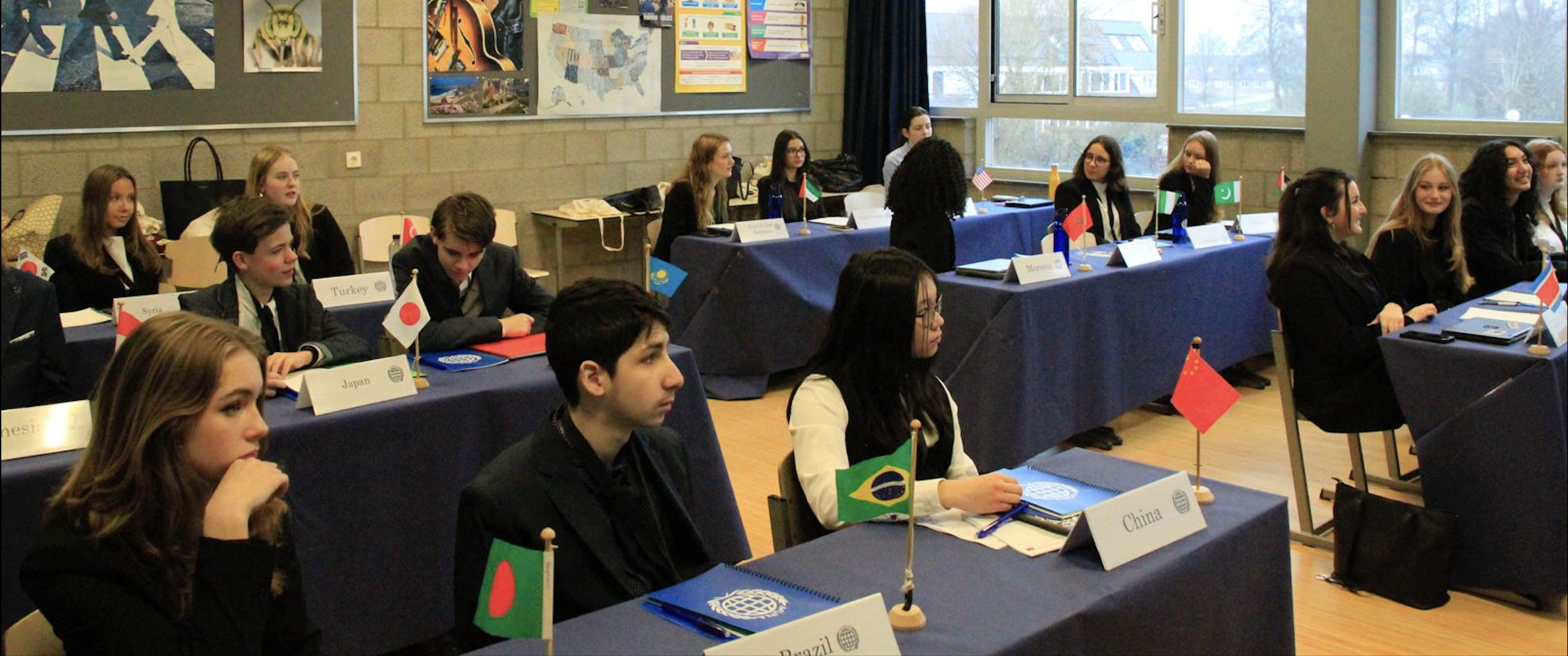
Like the real UN, MUNA is divided into several committees. They all cover different issues linked to a certain theme. Most committees at MUNA are based on real committees from the United Nations. Each committee is led by two student officers (a co-chair and a main chair) who are responsible for chairing the committee. They make sure everyone follows the rules and thereby ensure the fluency of the debate.
General Assemblies
Each GA committee will have one delegate per country. These delegates will be representing their country’s policy in those committees. After the sub- committees of the General Assembly have debated and approved a number ofresolutions, one or two of these approved resolutions will be addressed in the plenary session of the General Assembly. The General Assembly sub committees will address 3 or 4 issues per committee.
GA 1 – Disarmament and International security
This committee will focus on issues concerning disarmament and international security. This is the equivalent of the First Committee of the United Nations General Assembly. MUNA will not have another separate disarmament committee.
GA 2 – Human Rights
At the real UN, the Second Committee deals with economic and financial issues. Human rights issues at the real UN are discussed in the Human Rights Council. Because we have limited classrooms available at MUNA, we have no room for more than 11 committees. Therefore, we have decided to run a GA2 on human rights. The procedures are similar to other GA committees.
GA 3 – Environmental, Humanitarian and Health issues
This committee will focus on a number of different issues concerning current environmental, humanitarian and health; issues that affect people all over the world. Because of the pressing issue of the environment, MUNA added environment to its "Third Committee", and gave it a slightly different name than the name used at the real UN for its Third Committee (Social, Humanitarian and Cultural).
GA 4 – Special Political and Decolonization Committee
This commission of Special and Political Decolonization (SPECPOL) is mainly concerned about the well-being of non-self-governing territories, such as ex-colonies. It focuses on resolving the issues concerning the road to independence in a peaceful way. Over the years the focus of GA 4 has changed from dealing with ex-colonies to border issues and issues regarding (new) territories in general. For example, GA4 is also concerned with protecting natural resources and protecting the rights of indigenous people.
Other committees
Crisis Committee (CC)
The Crisis Committee is a committee in which delegates must respond quickly and decisively to sudden dramatic political, social, or environmental events. These events (or 'crises') become more intense and interconnected during the course of the conference, usually leading up to large-scale disasters by the end of the day, unless delegates are able to prevent them.
Economic and Social Council (ECOSOC)
The Economic and Social Council is a council in which delegates actively debate on issues concerning economic and social influences. Diving into the viewpoint of your own member state , you will consider, recommend and debate on several issues.
Global Mayor Forum (GMF)
The Global Mayor Forum is an exceptional committee within MUNA, where not nations, but the “mayors” of metropolitan cities come together to debate on topics related to the extent of sustainable, social and economic issues. The rules of procedure are the same as those of the GA’s; only the issues are focused more on the individual improvement of cities.
The Security Council I (SC)
The Security Council is the most powerful body in the United Nations and deals with questions regarding international security. The Security Council at MUNA will have one or two delegates representing each nation. MUNA always selects the countries that were present in the SC of the real UN in the year before the MUNA conference. The permanent members China, the United Kingdom, the United States of America, the Russian Federation and France are always present. The permanent five have the power of veto.
Advanced committees
The Security Council II (SC)
The Security Council is the most powerful body in the United Nations and deals with questions regarding international security. The Security Council at MUNA will have one or two delegates representing each nation. MUNA always selects the countries that were present in the SC of the real UN in the year before the MUNA conference. The permanent members China, the United Kingdom, the United States of America, the Russian Federation and France are always present. The permanent five have the power of veto. The rules are the same as any normal security council, expect that this version operates at a more advanced level.
Environmental Assembly
The Environmental Assembly focuses on defining priorities for environmental policies and developing international legislation on the matter; its course of debate is like the GA’s. The Environmental Assembly operates on a more advanced level; it is therefore for the advanced debaters.